
Ecom University - Ad Creative
Learn ecommerce ad creation with Ecom University. Explore video editing, static ads, AI tools, marketing fundamentals, and practical creative production skills.
4.8(154 ratings)- A course by
- Ecom University
- Rating
- 4.8(154 ratings)
- Updated
- Language
- English

$97
4.8(154 ratings)$99 for 1 year or $199 lifetime · unlocked on the Gmail you log in with
- Instant delivery
- Verified files
- WhatsApp support
- Pay on WhatsApp
What you'll learn
- Understand the fundamentals of ecommerce advertising
- Create engaging video ads with editing tools
- Design clear and effective static ads
- Apply AI tools to creative production
- Work from briefs and organize ad assets
- Develop ad creatives through practice and feedback
Proof
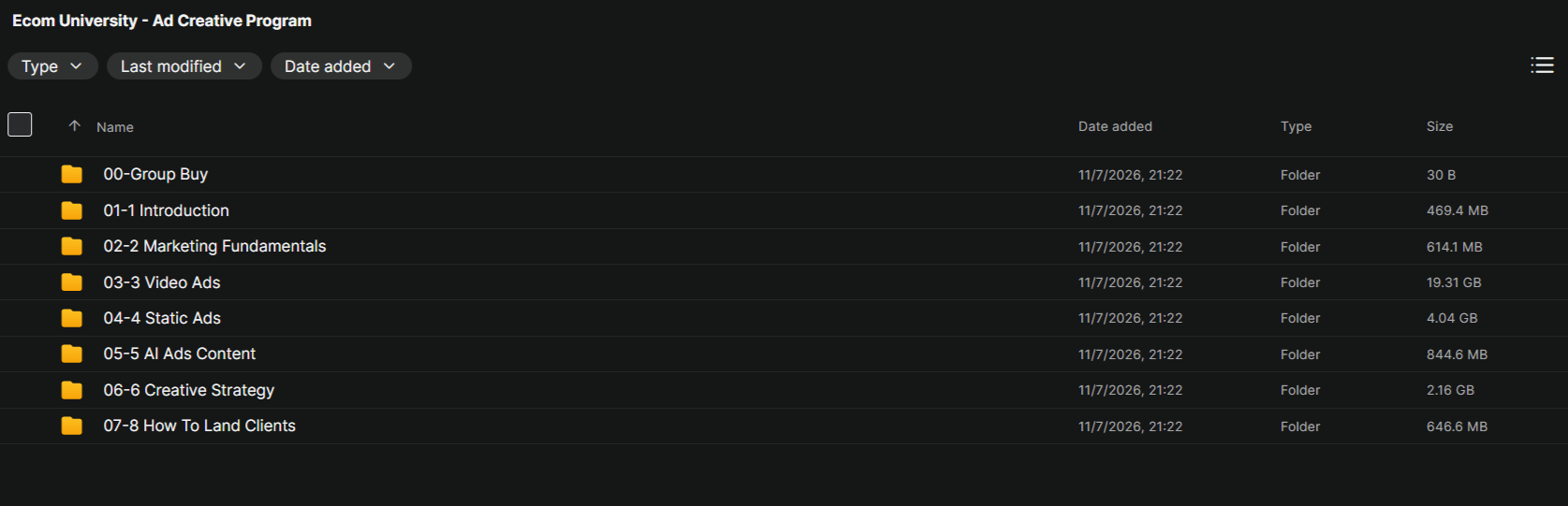
Course description
A product video can look polished, have professional lighting, and feature impressive editing — yet still fail to generate interest or sales.
The reason is simple: effective advertising requires more than attractive visuals. An ad needs to capture attention, connect with the right audience, communicate a relevant benefit, and encourage viewers to take action.
That is the difference between creating content and creating ad creative.
Ecom University's Ad Creative Program focuses on the skills and marketing principles behind ecommerce advertisements. It introduces learners to video ad production, static ad design, AI-assisted creative work, and the fundamentals of marketing that help shape an effective advertisement.
Whether you want to become a freelance ad editor, create image ads for online stores, or develop a practical understanding of ecommerce creative production, the program offers a structured starting point.
What Is Ecom University's Ad Creative Program?
Ecom University's Ad Creative Program is designed to teach the creative side of ecommerce advertising.
Instead of focusing only on editing software, the advertised curriculum connects marketing fundamentals with the process of producing video and static advertisements. This helps learners understand not just how to make an ad, but why certain creative decisions matter.
The program covers areas such as:
Direct-response marketing fundamentals
Social media marketing and consumer psychology
Understanding customers and their needs
Video ad formats, hooks, and viewer retention
Static advertising and visual design
AI-assisted ads and content production
Editing workflows using CapCut and Adobe Premiere Pro
Working from creative briefs and organizing assets
This combination is relevant to beginners who want to develop practical creative skills for ecommerce businesses.
Understand the Customer Before Creating an Ad
A strong advertisement starts with an understanding of the person who will see it.
Simply listing product features does not always give customers a reason to pay attention. People are more likely to respond when an advertisement connects a product to their needs, preferences, or problems.
For example, a skincare product might appeal to different customers for different reasons. One person may value convenience, another may be interested in specific ingredients, and someone else may be looking for a solution to a particular skin concern.
The program introduces marketing concepts such as consumer psychology, direct-response marketing, and customer understanding. These ideas help explain how product features can be presented as meaningful customer benefits.
Learning to think from the customer's perspective gives ad creators a stronger foundation for developing relevant messages.
Video Ad Creation: From Raw Footage to Finished Creative
Video is an important format in ecommerce advertising. Businesses use video to demonstrate products, explain features, show products in use, and communicate offers.
However, effective video production involves more than combining clips and adding transitions.
The program's advertised video training covers the anatomy of an advertisement, the role of an ad editor, creative formats, hooks, viewer retention, and the importance of showing rather than simply telling.
A typical video ad needs several elements:
Hook: Gives viewers a reason to keep watching.
Main message: Explains the product, benefit, or problem being addressed.
Visual sequence: Supports the message and keeps the advertisement engaging.
Call to action: Tells viewers what to do next.
The curriculum also introduces practical editing with tools such as CapCut and Adobe Premiere Pro. Learners are introduced to organizing creative assets, following a brief, and working through an initial ad project.
This can be useful for people who have tried basic video editing but want to understand how editing fits into a commercial advertising workflow.
Learn to Design Static Ecommerce Ads
Video is not the only format used by ecommerce brands. Static advertisements can also communicate product benefits, promotions, comparisons, and customer problems.
Because image ads often need to communicate quickly, clarity is especially important.
The program's static advertising section introduces image-based creative, visual layouts, design considerations, and the relationship between advertising copy and imagery.
A good static ad should have a clear visual hierarchy. The main message needs to stand out, while supporting information should make the advertisement easier to understand rather than compete for attention.
For example, an advertisement for a kitchen product could use a strong product image, a short benefit-focused headline, and one supporting detail. Adding too many messages or decorative elements can make the central idea harder to notice.
The goal is not to make every design complicated. It is to make the product and its value easy to understand.
Explore AI-Assisted Ad and Content Production
AI tools are becoming part of many creative workflows. They can help generate ideas, explore visual concepts, and support selected content production tasks.
Ecom University's advertised curriculum includes an AI ads and content component. It introduces learners to ways AI-assisted approaches can fit into the broader creative process.
However, AI should be treated as a supporting tool rather than a replacement for creative judgment.
Generated visuals may not accurately represent a product. AI-written copy may include claims that a business cannot substantiate, and generated videos may contain visual inconsistencies.
Every creative asset still needs human review for accuracy, brand suitability, originality, and advertising compliance.
Understanding both the benefits and limitations of AI can help learners use these tools more responsibly.
Understand the Marketing Behind Creative Decisions
Producing an advertisement and deciding what advertisement a business should produce are two different responsibilities.
An ad editor may receive a brief and turn it into a finished video. A creative strategist may research the audience, identify advertising angles, develop concepts, and guide the production team.
Ecom University offers a separate Creative Strategy track for learners who want to explore areas such as customer research, angle development, brief writing, and directing creative teams.
The distinction is worth understanding before choosing a learning path. People primarily interested in video editing and image ad production may find the Ad Creative track more relevant. Those interested in planning advertising concepts and guiding creative teams may want to explore Creative Strategy.
Work With Creative Briefs and Organize Your Projects
Professional creative work often begins with a brief.
A brief can explain the product, target audience, campaign objective, main message, reference examples, and required deliverables. Understanding these details helps an editor produce work that matches the business's expectations.
The program's advertised production lessons introduce working from a creative brief and organizing assets before editing.
These habits matter when handling client projects. Footage, images, audio, and project files should be organized so that the editing process remains manageable.
A consistent workflow can also make it easier to handle revisions, track different versions, and manage multiple projects.
Build Skills Through Practice and Feedback
Watching an editing lesson is not the same as completing an advertisement independently.
Practical work helps learners discover where their skills need improvement. An opening may be too slow, the product may not be shown clearly, or the message may not match the brief.
Ecom University's advertised learning model includes action items and practical application. Its program materials also describe opportunities to share work and receive feedback through the community.
Feedback can help learners identify specific changes to make in future projects.
Rather than focusing only on completing lessons, beginners should aim to develop a portfolio of practice work that demonstrates their creative process and progress.
Community Opportunities and Connections With Ecommerce Brands
Ecom University also promotes community initiatives intended to connect members with ecommerce businesses.
Its Ad Creative community advertises an Ad Bounty initiative through which brands can request creative work. Members may have opportunities to submit advertisements for consideration, and selected creative may be tested by participating brands.
The wider community also promotes a job board and opportunities to connect with brands.
These initiatives may interest learners who want to move beyond practice projects and explore commercial creative work. However, participation does not guarantee that a submission will be selected, that a brand will use the advertisement, or that a learner will earn money.
Availability and participation rules can change, so review the current community terms before relying on these opportunities.
Who Should Consider Ecom University's Ad Creative Program?
The program may be relevant to several types of learners:
Beginner video editors: People who know basic editing and want to understand ecommerce advertising.
Aspiring ad creators: Learners interested in producing video and image advertisements for online stores.
Freelancers: People who want to develop ad creative production as a service.
Content producers: Creators who want to understand how advertising content differs from organic social media content.
Ecommerce marketers: People who want a stronger understanding of creative formats and production workflows.
Career changers: Beginners exploring a creative skill they can practise through projects and portfolio development.
The program's central focus is creative production and the marketing principles that support it. It may not be the right fit for someone whose main goal is to study advanced media buying, campaign budgeting, or advertising account optimization.
What to Consider Before Starting
A laptop or desktop computer and a reliable internet connection are sensible starting points for this type of training. Editing applications and other creative tools may also have their own subscription costs and system requirements.
It is important to approach the learning process with realistic expectations. Your first advertisement may not look polished, and early creative concepts may need several revisions.
Building a portfolio through consistent practice can help demonstrate your abilities more effectively than simply listing a completed course.
Learners should also pay attention to copyright, music licensing, brand asset permissions, and the accuracy of product claims when creating advertisements for public display.
Key Takeaways
Effective ad creative combines marketing thinking with production skills.
Customer understanding helps shape relevant advertising messages.
Video ads require strong hooks, clear messaging, and purposeful editing.
Static ads depend on simple layouts and clear visual hierarchy.
AI can support production, but creative review remains essential.
Practice projects and feedback help develop practical skills.
Community opportunities should not be treated as guaranteed work or income.
Is Ecom University's Ad Creative Program Worth Exploring?
Ecom University's Ad Creative Program is aimed at people who want to understand ecommerce advertising from the creative production side.
Its advertised curriculum brings together marketing fundamentals, video ad editing, static creative, AI-assisted content, and practical production workflows. This combination can help beginners understand how an advertisement moves from an idea to a finished asset.
The biggest lesson is that effective ad creative is not just about transitions, effects, or attractive layouts. It is about communicating a relevant message to the right audience.
If you are interested in developing ecommerce ad creation skills, explore the program's current curriculum and community details. Then put what you learn into practice, seek feedback, and start building a portfolio that shows what you can create.
Member reviews
No reviews yet
Be the first member to review this course.
Write a review
Related courses

Fernando Oliver - Ecom Mastery AI
5.0(150 ratings)by Fernando Oliver
Master eCommerce copywriting, AI ad creation, VSLs, and sales funnels with Fernando Oliver's Ecom Blueprint to build and scale profitable online stores.
$997 · Included in Pro
Explore
Brook Hiddink - High Ticket E-Commerce Program
4.7(97 ratings)by Brook Hiddink
Learn high-ticket e-commerce with Brook Hiddink. Master Shopify, product research, supplier sourcing, Google Ads, SEO, and sustainable business growth.
$2000 · Included in Pro
Explore
Anthony Camacho - God Tier Ecom
4.9(115 ratings)by Anthony Camacho
Learn branded dropshipping, Facebook Ads, winning product research, and eCommerce scaling strategies with Anthony Camacho's God Tier Ecom mentorship.
$199 · Included in Pro
ExploreFree guides & comparisons
Helpful tutorials and platform comparisons related to this course.