
Ml School - Building AI/ML Systems That Don't Suck
Learn to build, evaluate, deploy, and monitor production-ready AI and machine learning systems through hands-on projects, Python, and expert guidance.
4.7(223 ratings)- A course by
- Ml School
- Rating
- 4.7(223 ratings)
- Updated
- Language
- English

$300
4.7(223 ratings)$99 for 1 year or $199 lifetime · unlocked on the Gmail you log in with
- Instant delivery
- Verified files
- WhatsApp support
- Pay on WhatsApp
What you'll learn
- Build production-ready AI and ML systems
- Prepare and evaluate machine learning models
- Deploy and monitor models in production
- Master model serving and data drift
- Build AI agents using MCP integrations
- Develop end-to-end ML workflows with Python
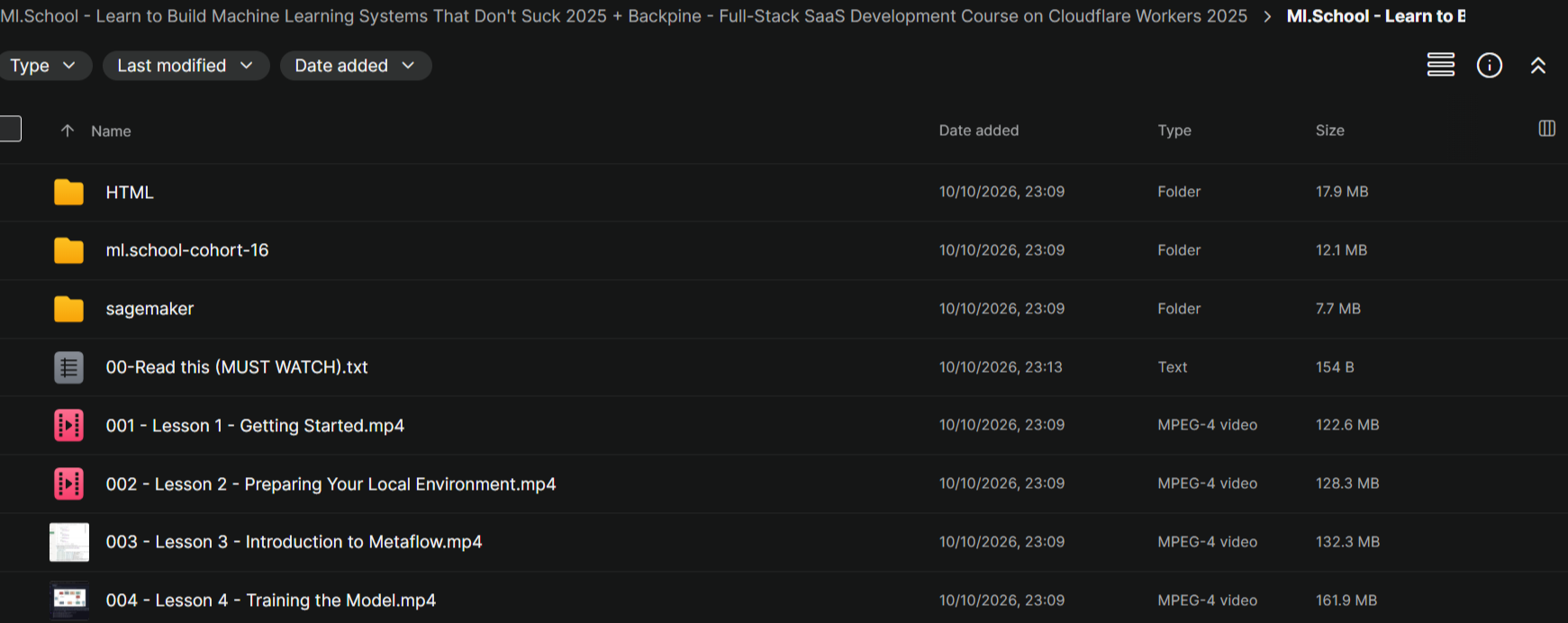
Proof
Course description
ML School – Learn to Build AI & Machine Learning Systems
Artificial Intelligence and Machine Learning are changing how modern software is developed, but building a working model is only one part of the process.
The real challenge begins when you need to turn that model into a reliable product. You need to prepare quality data, select the right model, evaluate its performance, deploy predictions, monitor results, and maintain the entire system as real-world conditions change.
That's exactly what ML School – Learn to Build AI & Machine Learning Systems is designed to teach.
Created by Santiago, an experienced Machine Learning Engineer with three decades of experience building enterprise software and AI/ML systems, this hands-on training program focuses on practical engineering skills rather than academic theory alone.
Through live sessions, practical code walkthroughs, real-world examples, and an end-to-end production-ready project, students learn how to design, build, and deploy AI and Machine Learning systems that solve actual business problems.
What Is ML School?
ML School is a practical AI and Machine Learning training program for developers and technical professionals who want to build production-ready machine learning applications.
Unlike introductory courses that focus primarily on algorithms and mathematical concepts, this program emphasizes the complete machine learning engineering lifecycle.
You learn how to approach projects, prepare datasets, select and evaluate models, deploy predictions, monitor performance, and improve systems over time.
The program includes six structured sessions, more than 20 hours of live interactive learning, three office hours, and access to an end-to-end system built from scratch.
Students also receive lifetime access to past and future cohorts, allowing them to revisit lessons and benefit from program updates.
What Will You Learn Inside ML School?
The program is organized into six sessions, each covering an important stage of building and maintaining AI and Machine Learning systems.
1. How to Start Almost Any Machine Learning Project
Every successful machine learning project starts with understanding the problem.
In the first session, you'll learn why many projects fail before development even begins and how to evaluate an idea before investing time and resources.
The training introduces an eight-question checklist to help simplify problems and establish a practical development direction.
You'll also explore why better data can be more valuable than more complicated models.
Key topics include:
Evaluating machine learning project requirements.
Understanding when machine learning is actually necessary.
Identifying data quality problems.
Collecting and labeling data at scale.
Transforming raw data into useful model features.
Determining when additional data is required.
2. How to Choose and Evaluate Machine Learning Models
Selecting a model isn't simply about finding the most advanced algorithm.
A model with high accuracy can still fail to solve the actual business problem. That's why understanding evaluation techniques and choosing appropriate performance metrics are essential.
This session teaches you how to select the simplest model that works and evaluate its performance using practical testing strategies.
You'll explore existing models, custom model development, fine-tuning, large language model evaluations, and safety guardrails.
You will also learn how to identify hidden model failures that a single performance metric might not reveal.
3. How to Prepare Models for Production
A machine learning model that works during development may behave differently when exposed to real-world data.
This session focuses on preparing models for production by improving data quality, handling unusual inputs, and preventing common performance problems.
You'll learn how outliers and edge cases affect predictions and why model outputs can sometimes introduce problems into future training data.
Another important topic is model versioning. Without proper version control, identifying the source of a problem and reproducing previous results can become difficult.
The session also explores ways to improve AI applications without constantly changing the underlying model.
4. How to Serve Model Predictions Efficiently
Once your model is ready, you need an effective way to deliver its predictions to applications and users.
This session explores different model-serving strategies and the trade-offs between speed, cost, and prediction accuracy.
You'll learn about:
Real-time versus precomputed predictions.
Two-phase prediction workflows.
Model gateways and application integration.
Caching techniques for reducing costs.
Human-in-the-loop workflows.
Model compression and performance optimization.
These techniques help developers design systems that deliver predictions efficiently while managing infrastructure costs and application requirements.
5. How to Monitor and Retrain Machine Learning Models
Deploying a model is not the end of machine learning development.
Production systems need continuous monitoring because real-world data can change over time. This problem is commonly known as data drift.
In this session, you'll learn what data drift means, why it affects model performance, and what developers should monitor after deployment.
You'll also explore how to test new models with real users, decide when retraining is necessary, and prevent models from forgetting previously learned information.
These practices are important for maintaining reliable AI and Machine Learning applications over time.
6. How to Build Agentic AI Systems
Modern AI development is moving beyond traditional predictive models toward systems that can interact with external tools, access information, and perform multi-step tasks.
The final session introduces agentic systems and explains how developers can extend AI capabilities beyond their original training data.
You'll explore:
Connecting models to external knowledge sources.
Understanding agentic workflows versus autonomous agents.
Using Model Context Protocol (MCP).
Connecting AI agents with external tools and data.
Enabling multiple agents to discover and collaborate with one another.
This session helps developers understand the engineering concepts behind more advanced AI-powered applications.
Build an End-to-End Production-Ready Machine Learning System
One of the most valuable parts of ML School is its practical codebase.
Students receive access to an end-to-end system template designed to demonstrate how machine learning workflows operate together.
The codebase includes functionality and documentation covering model training, evaluation, deployment, and monitoring.
You can explore how different components connect and understand how to adapt the architecture to your own projects.
Instead of learning isolated techniques, you get a practical view of how a complete machine learning system is designed and maintained.
Live Sessions, Office Hours, and Lifetime Access
ML School follows a structured cohort-based learning format.
Each cohort consists of six live sessions and three office hours spread across three weeks.
Live sessions are scheduled for Mondays and Thursdays, while office hours take place on Wednesdays. Sessions are recorded, so students who cannot attend live can catch up later.
Office hours provide an opportunity to ask questions, discuss technical challenges, share projects, and learn from other students.
The program also offers lifetime access to past and future cohorts, allowing members to revisit lessons and benefit from updated course material.
According to the provided program information, the program currently has no upcoming cohort dates.
Who Should Take ML School?
ML School is designed for people who already have some software development experience and want to build practical AI and Machine Learning skills.
It is particularly relevant to:
Software Developers: Build and integrate machine learning features into applications.
Data Scientists: Learn how to move models from experimentation into production.
Data Engineers: Understand the data workflows required for reliable ML systems.
Data Analysts: Expand technical knowledge toward machine learning engineering.
Technical Managers: Understand the practical requirements of delivering AI/ML projects.
Prerequisites
This is not a complete beginner program.
You should be comfortable writing code, preferably in Python, although experience with another programming language can also help.
Basic knowledge of cloud services and building and deploying simple APIs is recommended. Familiarity with Docker and containerization is helpful but not required.
You should also be prepared to participate, ask questions, and spend time working through practical material.
Who Is the Instructor Behind ML School?
ML School is taught by Santiago, a Machine Learning Engineer with approximately 30 years of experience building and scaling enterprise software and AI/ML systems.
Throughout his career, he has worked on projects involving major organizations such as Disney, Boston Dynamics, IBM, Dell, G4S, Anheuser-Busch, HP, and NextEra Energy.
He launched the program in March 2023 and reports that more than 2,000 students have graduated since its launch.
His teaching approach focuses on sharing practical engineering experience and the techniques needed to develop reliable systems in real-world environments.
Why Choose ML School for AI and Machine Learning Engineering?
Learning individual machine learning algorithms is useful, but professional AI development requires much more than understanding models.
You need to know how to evaluate business problems, prepare reliable data, select appropriate models, deploy predictions, monitor performance, and improve systems when conditions change.
ML School brings these skills together in a structured, practical learning experience.
Its combination of live instruction, production-oriented code walkthroughs, office hours, and lifetime cohort access makes it relevant to developers who want to move beyond theoretical machine learning knowledge.
Start Building Production-Ready AI Systems
Building useful AI and Machine Learning products requires practical engineering knowledge and a clear understanding of the entire development lifecycle.
ML School provides a structured opportunity to develop these skills through six focused sessions covering project planning, model evaluation, production deployment, model serving, monitoring, and agentic AI systems.
Whether you're a software developer, data scientist, or technical professional, the program can help you understand what it takes to turn machine learning concepts into working applications.
Ready to move beyond machine learning theory and build real AI-powered systems? Explore ML School and start developing the practical skills needed to design, deploy, and maintain production-ready AI and Machine Learning solutions.
Frequently Asked Questions (FAQs)
1. What is ML School?
ML School is a hands-on training program that teaches developers and technical professionals how to build, evaluate, deploy, and monitor production-ready AI and Machine Learning systems.
2. Is ML School suitable for complete beginners?
No. The program is not designed as an introductory course. Basic programming experience and familiarity with cloud services and APIs are recommended.
3. Do I need to know Python?
Python is the primary programming language used in the program. However, experience with another programming language can also provide a useful foundation.
4. How long does the program take?
Each cohort runs for three weeks and includes six live sessions and three office hours. Students should plan for at least four hours per week, with additional time for exploring the codebase.
5. What topics are covered in ML School?
The program covers project planning, data preparation, model selection, model evaluation, production deployment, model serving, monitoring, retraining, and agentic AI systems.
6. Will I learn how to deploy machine learning models?
Yes. The program includes practical lessons on preparing models for production, serving predictions, monitoring performance, and maintaining deployed systems.
7. Are live sessions recorded?
Yes. Every live session is recorded, allowing students to watch the lessons later if they cannot attend live.
8. Does ML School provide lifetime access?
According to the program description, enrollment includes lifetime access to past, present, and future cohorts.
9. Who teaches ML School?
The program is taught by Santiago, a Machine Learning Engineer with three decades of experience in enterprise software and AI/ML system development.
10. Will I build a real machine learning system?
The program includes a complete walkthrough of an end-to-end system built from scratch, along with access to a production-ready template covering training, evaluation, deployment, and monitoring.
Member reviews
No reviews yet
Be the first member to review this course.
Write a review
Related courses

Delaney William - Remote Job Accelerator
4.7(202 ratings)by Delaney William
Master AI-powered job search strategies, optimize your resume and LinkedIn profile, and discover how to land six-figure remote jobs and grow your income.
$197 · Included in Pro
Explore
Marcin Teodoru - AI Builders
4.8(164 ratings)by Marcin Teodoru
Learn to build apps, websites, SaaS products, and AI agents without coding through practical training, step-by-step projects, and expert community support.
$67 · Included in Pro
Explore
Sam Piliero - The Facebook Ads Blueprint
5.0(195 ratings)by Sam Piliero
Learn Facebook Ads with Sam Piliero's Blueprint. Master campaign structures, creative strategies, tracking, and systems for scaling eCommerce brands.
$297 · Included in Pro
ExploreFree guides & comparisons
Helpful tutorials and platform comparisons related to this course.
$300
Unlock from $99