
Donald Miller - Business Made Simple
Learn Donald Miller’s six-step plan to grow your small business. Improve leadership, marketing, sales, products, operations, and cash flow.
4.8(160 ratings)- A course by
- Donald Miller
- Rating
- 4.8(160 ratings)
- Updated
- Language
- English

$275
4.8(160 ratings)$99 for 1 year or $199 lifetime · unlocked on the Gmail you log in with
- Instant delivery
- Verified files
- WhatsApp support
- Pay on WhatsApp
What you'll learn
- Build a clear plan to grow your small business
- Create a mission that guides your team
- Improve marketing messages and sales pitches
- Optimize products for revenue and profit
- Organize team workflows and daily operations
- Manage business cash flow with a clear system
Proof
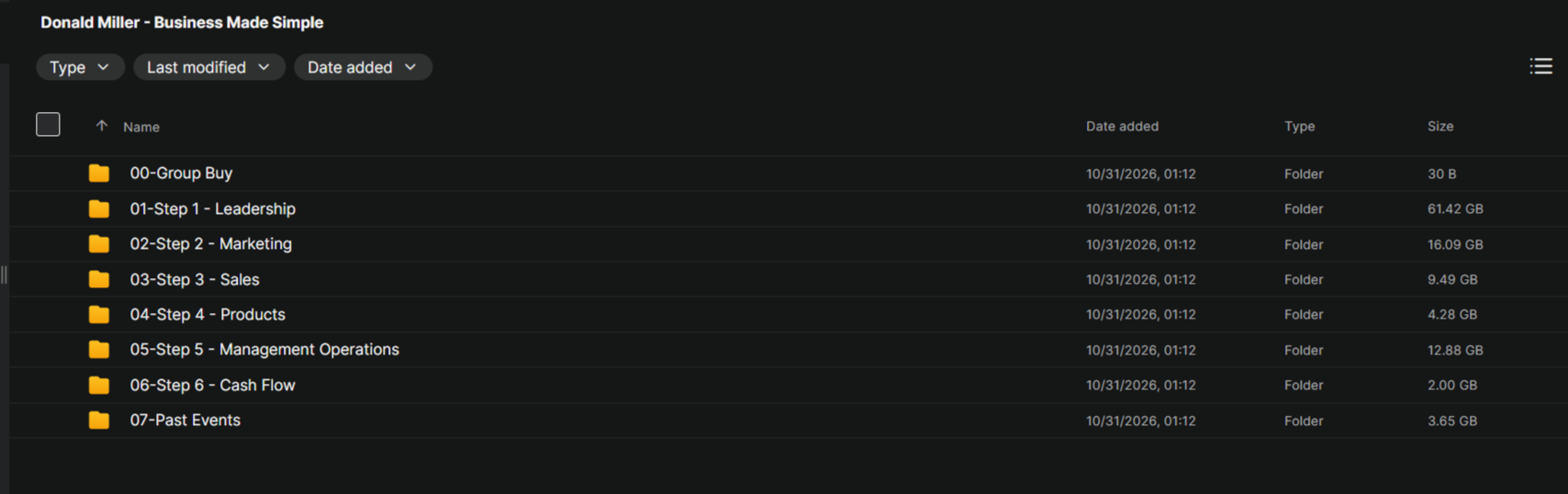
Course description
Growing a small business can feel like managing six different jobs at once.
You need to lead your team, attract customers, make sales, improve your products, manage daily operations, and keep enough money in the bank. Without a clear plan, it is easy to spend time on the wrong priorities while important parts of the business fall behind.
Business Made Simple by Donald Miller is designed to help business owners bring these responsibilities together through a practical six-step growth plan. Its on-demand courses focus on six key areas: leadership, marketing, sales, products, operations, and cash flow.
Instead of relying on guesswork, business owners can use these frameworks to identify what needs attention and take a more organized approach to growing their companies.
What Is Business Made Simple?
Business Made Simple is an online business education platform created to help small-business owners understand and improve the essential parts of running a company.
The platform offers on-demand courses, member-exclusive webinars, and a community where business owners can connect with peers and certified coaches. Its central approach is built around six business frameworks that work together as a growth plan.
The idea is straightforward: a business needs more than a good product or strong marketing. It also needs effective leadership, a sales process, organized operations, and a reliable way to manage money.
The six-step plan gives business owners a framework for working on each area.
The 6 Steps to Grow Your Small Business
Step 1: Business on a Mission – Leadership
A business needs direction before its team can work effectively toward shared goals.
The first course focuses on turning a mission statement into a set of guiding principles. These principles help communicate what the business stands for and give employees a clearer understanding of how decisions and actions should align with its purpose.
This leadership framework can help business owners:
Define the mission behind their company.
Establish principles that guide team decisions.
Give employees a clearer sense of direction.
Build a more consistent approach to leadership.
When people understand the purpose and values of a business, it becomes easier to create alignment across the team.
Step 2: StoryBrand Messaging Framework – Marketing
Customers are more likely to pay attention when they understand what a business offers and how it can help them.
The second step focuses on the StoryBrand Messaging Framework. Its purpose is to remove confusion from marketing messages so potential customers can understand the value of a product or service.
Rather than making the business the center of every message, the framework helps communicate around the customer's needs.
You can apply this approach to:
Website copy and landing pages.
Marketing campaigns and advertisements.
Product and service descriptions.
Everyday communication with potential customers.
Clear messaging makes it easier for customers to recognize what you offer and why it may be relevant to them.
Step 3: The Customer Is the Hero – Sales
Marketing helps attract attention, but a business also needs a clear way to turn interested prospects into customers.
The third course focuses on sales and the role of storytelling in a sales pitch. It teaches business owners how to structure a pitch around the customer and communicate the value of their offer.
A well-organized sales conversation should help customers understand the problem, see how the offer addresses it, and decide whether it is the right choice.
This framework focuses on improving the sales message rather than relying on confusing explanations or pressure-based conversations.
Step 4: Product Optimization Made Simple – Products
A business does not always need more customers to increase revenue. Sometimes, the opportunity lies in improving what it already sells.
The fourth step focuses on product optimization. It encourages business owners to examine their existing products and services to identify opportunities to improve revenue and profitability.
This means looking beyond simply adding new products. You also need to understand which offers provide value, how they fit customer needs, and whether the current product lineup supports business goals.
Product optimization can help you think more carefully about:
Your existing products and services.
The value each offer provides.
Opportunities to improve your product lineup.
Ways to support stronger revenue and profit.
The goal is to make your offerings work more effectively for the business and its customers.
Step 5: Management and Productivity Made Simple – Operations
As a small business grows, daily work can become increasingly difficult to manage.
Team members may take on too many responsibilities, processes may become inconsistent, and important tasks can get lost in the rush of daily operations.
The fifth course focuses on management, productivity, and organizing workflows. It aims to help business owners reduce operational confusion by creating a clearer structure for how work gets done.
This step is especially relevant if your team is constantly switching between responsibilities or struggling to understand who owns each task.
Better-organized operations can help a business use its time and people more effectively.
Step 6: Small Business Cash Flow Made Simple – Cash Flow
Revenue is important, but earning money does not automatically mean a business is managing its finances well.
The sixth course focuses on organizing small-business cash flow through a system built around five checking accounts. The aim is to help business owners manage incoming money and allocate funds more deliberately.
A structured cash-flow process can make it easier to understand where business money goes and plan for different financial responsibilities.
This final step highlights an important part of sustainable business management: knowing how to manage the money your business earns, not just how to generate revenue.
How the Six Steps Work Together
Each framework addresses a different part of running a business, but the six areas are connected.
Leadership gives your team direction. Marketing helps customers understand your offer, while sales gives them a clear path to becoming buyers. Product optimization focuses on the value of what you sell, and organized operations help your team deliver it consistently.
Cash-flow management supports the financial side of the business.
Looking at these areas together can help you identify weaknesses that might be difficult to spot when you focus on only one part of the company.
For example, stronger marketing may attract more potential customers, but a confusing sales process can prevent those prospects from buying. Similarly, increased sales can create new operational demands and cash-flow challenges.
A connected business plan helps you consider these relationships instead of treating every problem as a separate issue.
What Do You Get With Business Made Simple?
According to the supplied program information, membership costs $275 per year and includes:
Access to on-demand business courses.
Member-exclusive webinars.
A community of small-business owners and coaches.
Opportunities to ask questions and exchange practical advice.
Access to guidance from Business Made Simple Certified Coaches through the community.
The platform follows a simple learning process: watch the courses, execute the plan, and work toward growing your business.
You can study the material and apply the frameworks to your own business rather than relying on theory alone.
The Business Made Simple Community
Running a business can feel isolating, especially when you are responsible for making decisions across several departments.
Business Made Simple includes a community where members can connect with other small-business owners from different backgrounds. Members can ask questions, share challenges, and learn from people working through similar situations.
The community also provides access to advice from Business Made Simple Certified Coaches.
This peer-learning environment can be useful when you want to compare experiences, get another perspective, or discuss how to apply a business framework to a real situation.
Who Should Take Business Made Simple?
Business Made Simple is designed primarily for small-business owners who want a more organized approach to growth.
It may be particularly useful if:
You are unsure which business priorities to focus on.
Your marketing messages are not clear enough.
You want to improve your sales process.
Your products and services need closer evaluation.
Your team struggles with responsibilities and workflows.
You want a more structured approach to cash-flow management.
Business coaches may also find the frameworks relevant to their work with business owners. The platform separately promotes a coaching certification option for people interested in becoming Business Made Simple Certified Coaches.
How to Get the Most From the Courses
Watching business lessons is only the first part of improving a company. The value comes from applying what you learn to your actual business.
A practical way to approach the six-step plan is to review each area and identify where your biggest challenges currently exist.
Start by examining your mission and leadership principles. Then look at how clearly you communicate your offer, how you sell it, and whether your products provide the value customers expect.
Next, review your team's workflows and your approach to managing cash flow.
You do not have to change everything at once. Focus on understanding each framework and applying the relevant ideas consistently.
Frequently Asked Questions
What is Business Made Simple by Donald Miller?
Business Made Simple is an online business education platform that provides on-demand courses, webinars, and a community for small-business owners and coaches. Its core learning plan covers six areas of business management and growth.
What are the six steps in the program?
The six steps cover leadership, marketing, sales, products, overhead and operations, and cash flow. Each step focuses on a different part of running and improving a small business.
How much does Business Made Simple cost?
The supplied program information lists membership at $275 per year. It includes access to on-demand courses, member-exclusive webinars, and the business community.
Is Business Made Simple only for business owners?
The platform is designed for business owners and also offers a separate coaching certification pathway. Its community includes small-business owners and coaches.
Can I apply the lessons to an existing business?
Yes. The six frameworks are presented as tools for evaluating and improving key areas of an existing small business, including leadership, marketing, sales, products, operations, and cash flow.
Build a Clearer Plan for Your Business
Growing a small business requires more than working longer hours or trying every new strategy. It takes clear leadership, effective communication, a reliable sales process, valuable products, organized operations, and thoughtful financial management.
Donald Miller's Business Made Simple brings these six areas together in one structured learning plan. Its courses and community are designed to help business owners understand what needs attention and take practical steps toward improving their companies.
If you want a clearer way to approach business growth, explore the Business Made Simple courses and start building a plan around the six areas that keep your business moving forward.
Member reviews
No reviews yet
Be the first member to review this course.
Write a review
Related courses

Caleb Hammer - Master Your Money Bundle
4.9(116 ratings)by Genie Team
Learn budgeting, debt management, investing, and real estate with Caleb Hammer’s four-course bundle, featuring practical lessons, tools, and worksheets.
$667 · Included in Pro
Explore
Christine Ivette - 7 Ways To Wealth
4.7(128 ratings)by Genie Team
Explore Christine Ivette’s Wealthy Trustee Program to learn about trust structures, asset protection, wealth preservation, and generational legacy planning.
$2500 · Included in Pro
Explore
Matthew Larsen - 10k Per Month
5.0(153 ratings)by Matthew Larsen
Learn how to grow your agency to $10K per month with proven strategies for sales, offers, client outreach, content creation, and business development.
$97 · Included in Pro
ExploreFree guides & comparisons
Helpful tutorials and platform comparisons related to this course.
$275
Unlock from $99