
Rich Schefren - Personal AI Operating System
Learn how to build a personal AI operating system with Rich Schefren and use AI to sharpen strategic thinking, improve decisions, and gain business advantage.
5.0(180 ratings)- A course by
- Rich Schefren
- Rating
- 5.0(180 ratings)
- Updated
- Language
- English
$97
5.0(180 ratings)$99 for 1 year or $199 lifetime · unlocked on the Gmail you log in with
- Instant delivery
- Verified files
- WhatsApp support
- Pay on WhatsApp
What you'll learn
- Build a personal AI operating system
- Use AI to strengthen strategic thinking
- Make clearer and more confident decisions
- Move from AI user to AI strategist
- Apply AI to business strategy and growth
- Develop a lasting strategic advantage
Course description
AI is changing how businesses operate. But using more AI tools does not automatically make a founder more strategic.
You can generate content faster, automate routine tasks, and improve daily workflows. Yet, if your underlying thinking stays the same, your business may simply move faster in the same direction.
That is the problem Rich Schefren wants founders to address through his AI Strategist approach.
His vision goes beyond learning prompts or experimenting with new tools. It focuses on developing a stronger relationship with AI—one that helps business owners see opportunities, make better decisions, and build a lasting strategic advantage.
At the starting point of this journey is ZenithMind OS, a personal AI operating system designed to support clearer strategic thinking.
This article explores the AI Strategist philosophy, the role of a personal AI operating system, and how Rich Schefren's wider ecosystem is structured for serious founders.
What Is Rich Schefren's Personal AI Operating System?
Rich Schefren's Personal AI Operating System is presented through the ZenithMind OS offering, the first step in his broader AI Strategist progression.
The central idea is straightforward: AI should do more than help you complete tasks. It should improve how you think about your business.
Many entrepreneurs begin their AI journey by asking tools to write emails, create marketing content, summarize information, or automate repetitive work. These applications can save time, but they do not necessarily improve the quality of business decisions.
A personal AI operating system represents a different approach. Instead of treating AI as an occasional assistant, the goal is to make it part of a more consistent process for thinking, evaluating ideas, and approaching important decisions.
The emphasis is on building a personal system that supports strategic clarity rather than collecting another set of disconnected AI tools.
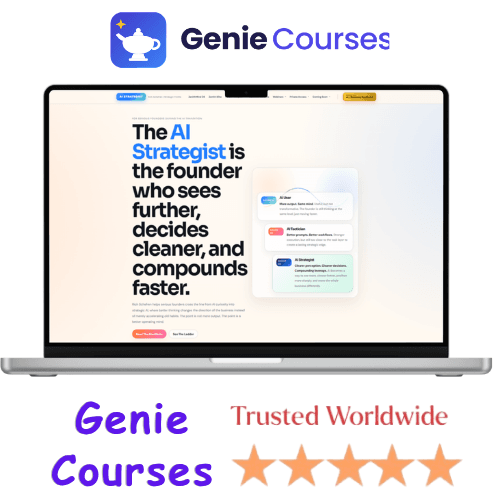
From AI User to AI Strategist
Rich Schefren describes three stages in the way founders approach artificial intelligence.
Understanding these stages helps explain why his approach places so much importance on strategic thinking.
1. The AI User: More Output, Same Thinking
An AI User employs artificial intelligence to complete tasks more quickly.
They might use AI to write content, research topics, generate ideas, or handle everyday business activities. These applications are useful, but the founder remains the primary source of direction and judgment.
The limitation is that faster execution does not necessarily produce better strategy.
If the original thinking is unclear, AI can simply help produce more work based on that unclear thinking.
2. The AI Tactician: Better Prompts and Workflows
The next stage involves using AI more deliberately.
An AI Tactician understands how to improve prompts, organize workflows, and use tools more effectively. This can lead to better execution and more consistent results.
However, according to the AI Strategist philosophy, this level can still focus too heavily on individual tasks.
The bigger opportunity is to use AI to improve the decisions behind those tasks.
3. The AI Strategist: Clearer Thinking and Better Decisions
The AI Strategist represents the highest level in this three-stage framework.
At this level, AI becomes part of how a founder examines opportunities, frames problems, evaluates options, and decides where the business should go.
The objective is not simply to increase output. It is to improve perception, judgment, and strategic direction.
This is the shift Rich Schefren wants serious founders to make.
Why Strategic Thinking Matters More Than AI Tools
AI tools are becoming increasingly accessible. Business owners can experiment with different platforms, automate processes, and generate content without needing extensive technical knowledge.
But access to technology is not the same as having a competitive advantage.
The quality of the result still depends heavily on the quality of the thinking guiding the process.
Consider two founders using similar AI tools. One has a clear understanding of their market, business model, customers, and priorities. The other has not clearly defined what they want to achieve.
Both may use AI to generate ideas or plan their next marketing campaign. But the founder with stronger strategic direction is better positioned to evaluate the suggestions and choose the right actions.
This reflects three important principles behind the AI Strategist approach:
The bottleneck is not access: Having AI tools is no longer enough to create a meaningful advantage.
Strategy determines amplification: AI can strengthen good thinking, but it can also accelerate weak decisions.
Capability creates differentiation: Founders who use AI to improve strategic judgment may develop advantages beyond faster task completion.
A personal AI operating system fits into this philosophy by making AI part of a more intentional thinking process.
ZenithMind OS: The First Step in the AI Strategist Journey
ZenithMind OS is positioned as the starting point of Rich Schefren's wider AI Strategist ecosystem.
Its central promise is to help founders build a personal AI operating system for clearer strategic thinking.
This makes it particularly relevant to entrepreneurs who want to move beyond basic AI experimentation and develop a more deliberate approach to using artificial intelligence.
Rather than presenting the journey as a collection of unrelated software tutorials, the broader philosophy connects AI with the founder's ability to think, choose, and build.
The important distinction is the level of focus: the goal is not just to learn another tool, but to develop a more strategic way of working with AI.
The specific features, technical setup process, and detailed training curriculum for ZenithMind OS should be checked against its current program materials.
Explore Rich Schefren's Five-Level AI Strategist Ecosystem
ZenithMind OS is the first step in a larger progression. Rich Schefren presents five levels of access and business integration, each designed for a different stage of seriousness and involvement.
Step 1: ZenithMind OS
The starting point is building a personal AI operating system.
This level is intended for founders who want to develop a stronger foundation for strategic thinking with AI.
Step 2: ZenithMind Elite
The next level moves from a personal system toward a business system.
The focus shifts to installing AI into the business rather than using it only as an individual productivity tool.
Step 3: Force Multiplier
Force Multiplier takes the concept further by focusing on an AI-led strategic organization.
The stated objective is to help the whole business become clearer, faster, and more strategically capable.
This stage represents a move from individual AI use toward a broader organizational advantage.
Step 4: Connect the Dots
Connect the Dots is positioned as a private-access opportunity.
It is intended for founders who want closer exposure to Rich's thinking, strategic distinctions, and working environment.
The focus is less on broad access and more on proximity to the ideas and decisions shaping his approach.
Step 5: Maximum Profit
Maximum Profit represents the invitation-only upper tier described on the website.
It is designed for founders seeking ongoing access, strategic calibration, and closer proximity to Rich's evolving work.
Together, these five levels create a progression from personal AI development to business-wide integration and private strategic access.
Who Can Benefit From a Personal AI Operating System?
The AI Strategist philosophy is aimed primarily at serious founders and entrepreneurs navigating the transition toward AI-powered business operations.
It may be particularly relevant if you:
Use AI regularly but want to apply it more strategically.
Want to improve the quality of your business decisions.
Are exploring ways to integrate AI into your company's operations.
Want to move beyond isolated prompts and disconnected tools.
Are looking for a more structured approach to AI and business strategy.
Want to understand how AI could influence your company's long-term direction.
It may be less relevant if your only goal is to find a basic introduction to AI tools or learn a few quick productivity tricks. The positioning is strategic rather than focused on simple tool demonstrations.
Who Is Rich Schefren?
Rich Schefren is presented as an entrepreneur and strategic business thinker whose work has focused on identifying major shifts in online business.
The AI Strategist website highlights several milestones from his earlier work.
In 2006, he helped define the lead magnet era and published the Internet Business Manifesto, which the website says was downloaded more than five million times.
In 2007, his work addressed the growing importance of social media, online attention, and video sales letters.
In 2008, he helped popularize the automated webinar as a mechanism for generating demand and scaling online businesses.
Today, he is applying this pattern-recognition approach to artificial intelligence.
The central message is that founders should understand the strategic implications of a major technological shift before it becomes standard practice across the market.
Key Takeaways
Here are the main ideas behind Rich Schefren's Personal AI Operating System and the wider AI Strategist approach:
AI should improve thinking, not just increase output.
Better prompts and workflows are useful, but they are not the entire strategy.
ZenithMind OS is positioned as the starting point for building a personal AI operating system.
ZenithMind Elite moves the focus toward business-level AI integration.
Force Multiplier focuses on an AI-led strategic organization.
Connect the Dots and Maximum Profit provide more private levels of access.
The broader objective is to help founders make clearer decisions and develop a stronger strategic advantage.
Is Rich Schefren's Personal AI Operating System Worth Exploring?
If you are a founder who already understands the basic uses of AI, the next challenge may not be finding more tools. It may be learning how to use artificial intelligence to improve the way you evaluate opportunities and make decisions.
That is the central idea behind Rich Schefren's AI Strategist philosophy.
ZenithMind OS provides the entry point into this approach, while the wider ecosystem offers a progression toward business integration, organizational leverage, and private strategic access.
Before choosing a program, review its current curriculum, deliverables, access terms, and pricing to make sure they match your business needs.
Member reviews
No reviews yet
Be the first member to review this course.
Write a review
Related courses
Marcin Teodoru - AI Builders
4.8(164 ratings)by Marcin Teodoru
Learn to build apps, websites, SaaS products, and AI agents without coding through practical training, step-by-step projects, and expert community support.
$67 · Included in Pro
Explore
Nate Herk - AI Automation Society Plus
4.7(213 ratings)by Nate Herk
Learn AI automation, master Claude Code, build a client-ready portfolio, land paying clients, and scale your agency with Nate Herk's practical training.
$129 · Included in Pro
Explore
Nicolas Gorrono - AI Ranking
4.8(207 ratings)by Nicolas Gorrono
Master AI-powered SEO with DataWise, practical workflows, keyword research, competitor analysis, and proven strategies to grow rankings, traffic, leads, and sales.
$27 · Included in Pro
ExploreFree guides & comparisons
Helpful tutorials and platform comparisons related to this course.