David Gyori - Video Makers by AI Agents A-Z
Learn to build, test, and deploy autonomous AI agents with David Gyori. Master agent workflows, orchestration, automation, and safety.
4.9(195 ratings)- A course by
- David Gyori
- Rating
- 4.9(195 ratings)
- Updated
- Language
- English
$69
4.9(195 ratings)$99 for 1 year or $199 lifetime · unlocked on the Gmail you log in with
- Instant delivery
- Verified files
- WhatsApp support
- Pay on WhatsApp
What you'll learn
- Build autonomous AI agents for real-world tasks
- Master AI agent orchestration and workflows
- Design prompts and reusable agent systems
- Evaluate agent performance and reliability
- Implement AI safety and governance guardrails
- Deploy and scale production-ready AI agents
Proof
Course description
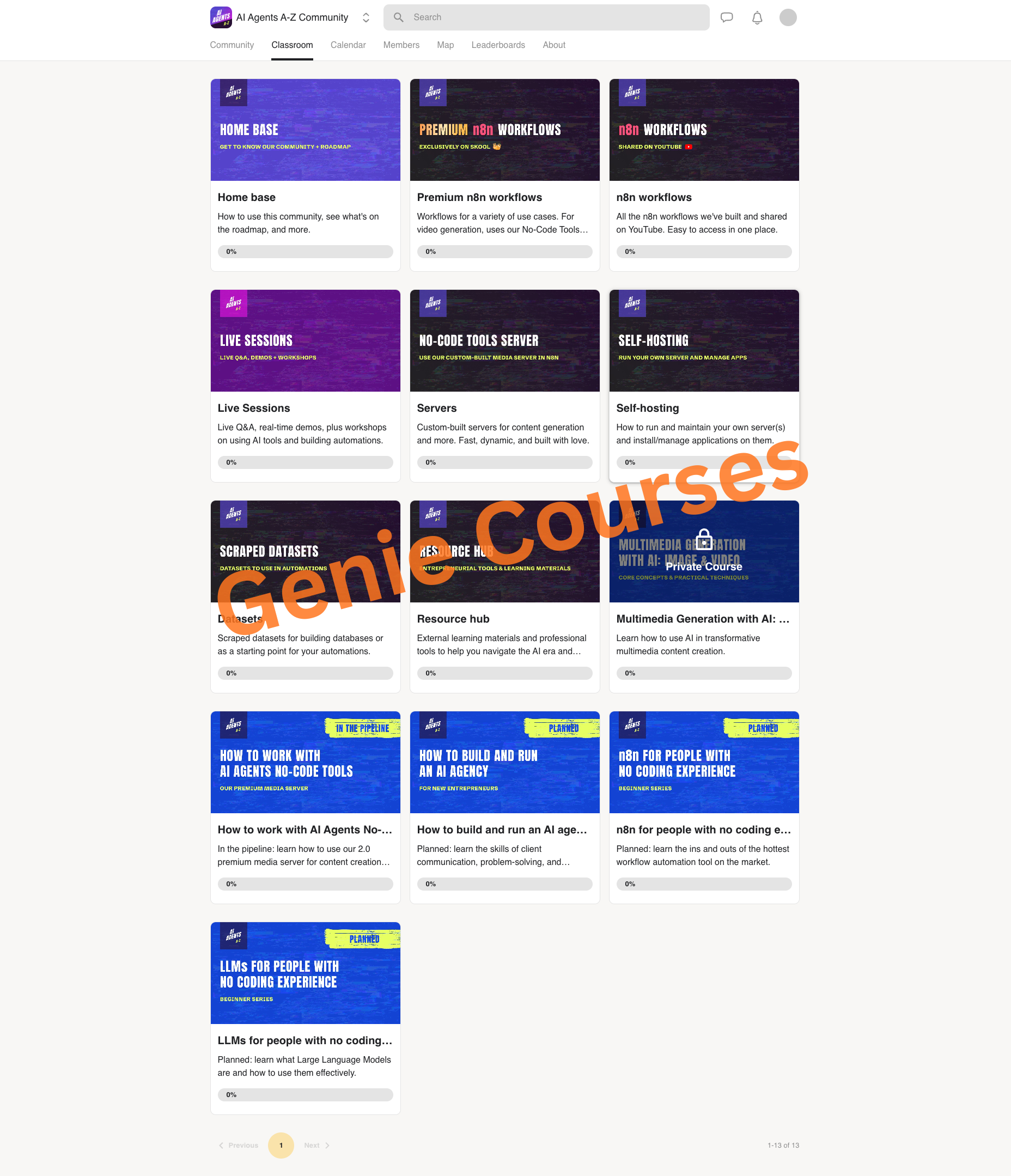
David Gyori – AI Agents A-Z Community: Learn to Build and Deploy Autonomous AI Agents
Artificial intelligence is changing how businesses operate, how teams manage tasks, and how software gets built. AI tools can already generate content, analyze information, and assist with everyday work. But the next step is moving beyond simple AI conversations toward autonomous agents that can complete complex tasks with minimal human intervention.
That's where David Gyori – AI Agents A-Z Community comes in.
AI Agents A-Z Community is a comprehensive training program designed for developers, business owners, product managers, and professionals who want to build and deploy practical AI agents. It focuses on the complete process of creating autonomous systems, from initial planning and workflow design to testing, deployment, and ongoing optimization.
Rather than focusing only on theoretical AI concepts, the program emphasizes practical implementation, reusable frameworks, safety practices, and real-world automation.
What Is David Gyori's AI Agents A-Z Community?
AI Agents A-Z Community is a learning program that teaches participants how to design, build, evaluate, and scale autonomous AI agents.
An AI agent can be designed to understand a task, create a plan, use external tools, process information, and complete multiple steps toward a specific objective.
For example, an AI-powered customer support agent might receive a customer request, retrieve relevant information, determine the appropriate response, and complete certain actions within an approved workflow.
The program explores how to create these systems using structured prompts, agent orchestration, modular architecture, evaluation frameworks, and governance practices.
It also provides a community-based learning environment where participants can access templates, frameworks, practical guidance, and collaborative feedback.
What Will You Learn Inside AI Agents A-Z Community?
The curriculum covers several important areas of autonomous AI development.
1. AI Agent Architecture and Orchestration
Building an autonomous agent requires more than writing a good prompt. You need to understand how different components communicate, share information, and complete tasks.
The program introduces agent orchestration techniques that help coordinate complex workflows and troubleshoot problems when agents fail or produce unexpected results.
You'll explore modular agent design, workflow coordination, and strategies for connecting multiple agents with external tools and data sources.
2. Plan-Execute-Reflect Workflows
One important concept in autonomous AI development is the Plan-Execute-Reflect approach.
This method allows an agent to break a complex task into smaller steps, execute those steps, evaluate the results, and adjust its approach when necessary.
Instead of responding to every instruction with a single output, agents can follow a structured process that supports multi-step problem-solving.
This approach is particularly useful for research, reporting, customer support, and business process automation.
3. Prompt Engineering and Habitual Prompting
AI agents depend on clear instructions to perform tasks consistently.
The program explores prompt design and system messages through the concept of Habitual Prompting. The objective is to establish reusable instruction patterns that help agents follow expected behavior across different tasks.
You'll learn how to structure prompts, define agent responsibilities, provide relevant context, and improve the consistency of AI-generated results.
4. Agent Evaluation and Benchmarking
An autonomous agent isn't useful simply because it can complete a task once. It needs to perform reliably across different situations.
AI Agents A-Z Community covers benchmarking frameworks and evaluation methods for measuring agent performance.
These techniques help assess factors such as accuracy, speed, reliability, and overall task completion.
By identifying weaknesses and measuring results, you can improve your agents through structured testing and continuous feedback.
5. Workflow Automation and Tool Integration
Modern AI agents become more powerful when they can interact with external systems.
The program explores workflow orchestration and integrations that connect agents with APIs, data sources, tools, and business processes.
You can learn how to organize automated workflows, coordinate different operations, and create reusable systems that reduce repetitive manual work.
6. AI Safety, Guardrails, and Governance
Autonomous AI systems need clear boundaries.
Without appropriate controls, agents may access unintended information, produce unreliable outputs, or perform actions that create operational risks.
The program emphasizes guardrails, governance frameworks, audit trails, and safety practices to support responsible AI deployment.
These concepts are especially important for organizations that want to introduce AI automation while maintaining control over sensitive information and automated decisions.
What's Inside AI Agents A-Z Community?
The program combines educational material with practical resources designed to support implementation.
Its advertised learning areas include:
Funnel Architecture: Understand scalable agent structures, modular design, and orchestration strategies.
Traffic Mastery: Learn how to route tasks, manage queues, and improve workflow efficiency.
Conversion Optimization: Evaluate agent decisions and improve performance through testing.
Scaling Strategies: Explore ways to move AI projects from initial experiments to larger deployments.
Revenue Systems: Understand how agents can support automated business and revenue-related workflows.
Automation Framework: Develop reusable systems for building, testing, and deploying agents.
Governance and Safety: Establish guardrails, audit trails, and responsible AI practices.
Agent Evaluation: Measure accuracy, reliability, and overall performance.
Tooling and Integration: Connect agents with external APIs, tools, and data sources.
Real-World Case Studies: Explore practical agent applications and implementation lessons.
Capstone Project: Bring different concepts together in an end-to-end AI agent project.
This structure helps learners understand both the technical and operational requirements of autonomous AI systems.
Exclusive Bonuses and Community Resources
AI Agents A-Z Community also describes several additional resources intended to make implementation easier.
Agent Playbook Kit
A collection of playbooks, templates, and checklists for designing, testing, and deploying AI agents.
Guardrails Master Bundle
Governance patterns, safety checks, risk assessment resources, and incident-response guidance for responsible AI implementation.
Templates Vault
Reusable templates for prompts, workflows, and evaluation dashboards that can help standardize development processes.
Live Office Hours and Community Support
Participants are offered access to community discussions, live office hours, and feedback opportunities to discuss implementation challenges and improve their projects.
Case Studies and Ongoing Updates
The program also describes a growing case study repository and ongoing updates to educational materials, templates, and frameworks as AI technologies evolve.
The supplied program description also mentions progressive certification and community peer reviews.
Who Should Join AI Agents A-Z Community?
This program may be particularly useful for people who want to apply AI automation to practical business and technical challenges.
Developers and engineers: Learn reusable approaches for designing, integrating, testing, and deploying autonomous agents.
Product managers and business operators: Explore ways to automate repetitive processes and improve operational efficiency.
CTOs and technology leaders: Understand AI governance, safety, accountability, and scalable implementation.
Consultants and freelancers: Develop repeatable frameworks for building AI-powered solutions for different clients.
Analysts and researchers: Explore automated data collection, research, information processing, and reporting workflows.
Marketing professionals: Understand how AI agents can support lead qualification, content workflows, and competitive research.
The program is best suited to learners who are willing to experiment, build practical projects, and continuously improve their systems.
How AI Agents A-Z Community Helps You Move From Ideas to Deployment
One of the biggest challenges in AI development is turning an interesting experiment into a reliable system.
An agent might work perfectly in a simple demonstration but struggle when it encounters incomplete information, unexpected inputs, or external tool failures.
AI Agents A-Z Community addresses this challenge through a structured development approach.
You begin by identifying a problem that can benefit from automation. Next, you define the agent's responsibilities, design its workflow, connect the required tools, and establish clear instructions.
After building an initial version, you test the agent against different scenarios and evaluate its performance.
You then introduce appropriate guardrails, monitoring processes, and feedback loops before considering a larger deployment.
This approach helps create AI systems that are easier to understand, maintain, evaluate, and improve.
About David Gyori
David Gyori is presented as the creator and instructor behind AI Agents A-Z Community.
According to the supplied program description, his approach focuses on practical AI implementation, product development, automation strategy, and helping teams move toward scalable AI-powered operations.
The program reflects this practical focus by combining agent architecture, workflow automation, evaluation, governance, and community-based learning.
Rather than concentrating exclusively on individual AI tools, its central theme is developing repeatable systems that can be adapted to different business and technical requirements.
Frequently Asked Questions
1. What is AI Agents A-Z Community?
AI Agents A-Z Community by David Gyori is a training program focused on building, testing, deploying, and managing autonomous AI agents for real-world tasks.
2. Do I need coding experience?
Basic coding and data workflow knowledge can be helpful, particularly for technical implementation. However, the supplied description presents the program as accessible to both technical and semi-technical learners.
3. What is agent orchestration?
Agent orchestration is the process of coordinating agents, tools, and workflows so they can work together to complete complex tasks.
4. What is the Plan-Execute-Reflect method?
It is a structured approach in which an AI agent plans a task, executes the required steps, evaluates the results, and adjusts its approach when needed.
5. Does the program cover AI safety?
Yes. The supplied curriculum includes guardrails, governance, audit trails, risk assessment, and responsible AI implementation.
6. What resources are included?
The program description mentions playbooks, templates, checklists, safety resources, case studies, live office hours, community peer reviews, and ongoing updates.
7. How long does it take to build an AI agent?
The timeline depends on the project's complexity, available tools, and your experience. The supplied description suggests that learners may begin building basic agents within several weeks, but production deployment can require additional testing and refinement.
8. Who is AI Agents A-Z Community best for?
It is designed for developers, engineers, product managers, business operators, consultants, researchers, and professionals interested in practical AI automation.
Start Building Autonomous AI Agents With Confidence
AI agents are creating new opportunities to automate workflows, coordinate complex tasks, and improve how businesses operate.
But building reliable agents requires more than choosing an AI model. You need structured workflows, effective prompts, proper integrations, performance evaluation, and safety controls.
David Gyori's AI Agents A-Z Community brings these areas together in one learning environment, with practical frameworks, templates, case studies, and community support.
If you want to move beyond basic AI experiments and understand how to build autonomous systems for real-world applications, this program provides a structured starting point.
Explore AI Agents A-Z Community and start developing the skills to design, build, and deploy smarter AI-powered workflows.
Member reviews
No reviews yet
Be the first member to review this course.
Write a review
Related courses

Daniel Riley - AI Video Bootcamp
4.9(219 ratings)by Daniel Riley
Learn AI video and image creation with Daniel Riley’s AI Video Bootcamp. Build AI influencers, UGC ads, digital twins, and creative content for brands online.
$9 · Included in Pro
Explore
Tapewarp.ai - AI UGC Crash Course
4.9(210 ratings)by Tapewarp.ai
Learn to create realistic AI influencers, produce engaging UGC videos, generate brand-ready visuals, and build scalable AI content creation workflows.
$299 · Included in Pro
Explore
Marcin Teodoru - AI Builders
4.8(164 ratings)by Marcin Teodoru
Learn to build apps, websites, SaaS products, and AI agents without coding through practical training, step-by-step projects, and expert community support.
$67 · Included in Pro
ExploreFree guides & comparisons
Helpful tutorials and platform comparisons related to this course.